
10 Moments That Taught People Kindness Is the Closest Thing to Lasting Happiness

Kindness is the only true path to lasting happiness. It’s not something that works only occasionally or for a select few—it’s the constant force that shapes the lives of the happiest people I’ve ever known. These individuals weren’t necessarily the wealthiest or the luckiest; they were simply people who made kindness a daily habit. It became part of who they were.
Here are 10 stories that show how choosing kindness, in small, often overlooked moments, can build the foundation for genuine and lasting happiness.
My landlord waived my rent for 5 months after my husband left. I had two children and no job. His wife screamed at him, saying, We’re not running a charity! She wouldn’t speak to him for weeks. Three years later, I found out the real reason he helped me. He grew up watching his mother get evicted multiple times, and he promised himself that no single mother would ever lose her home on his watch. His wife never knew this. When she found out, she came to apologize. I didn’t know. He never told me why. They were fine after that, and she started helping too. I paid him back every cent two years later. He tried to refuse, but I said, Take it. So you can do it again for someone else.

My grandmother called every Sunday at 11 a.m. for 23 years, without exception. I wasn’t always the best grandson, sometimes ignoring the calls, or keeping them brief. She always knew when I wasn’t fully present, but she was gracious about it. After she passed, I found myself sitting by my phone at 11 a.m. every Sunday, not realizing it at first. It’s become a ritual I continue, and I’m not sure I want to stop. It’s the closest I’ll ever come to hearing that call again.
One day, I received a text from an unknown number saying, Just checking in, how are you holding up? I thought they had the wrong person, so I apologized. They explained they had meant to text their friend who had just lost his father. I replied, I’m sorry for your loss. Then, I paused and typed, For what it’s worth, the fact that you’re checking on him speaks volumes about you. They responded, Thank you. I almost didn’t send the text because I didn’t know what to say. I replied, “He’ll forget what you said, but he’ll remember that you reached out.” We never exchanged another word, but I often think about that conversation when I hesitate to send a message to someone. There are no perfect words—just send the message anyway.

I deliver mail in a small town, and there’s an elderly woman on my route who hadn’t received a personal letter in years, just bills and junk mail. One December, I decided to write her a simple Christmas card and slipped it into her mailbox. She called the post office, crying—not because of the message, but because someone had remembered her. Since then, I’ve written her a card every month. Now, she sits on her porch waiting for me—not for the card, but just to wave. That wave is the best part of my entire route.
My co-worker Sandra always ate lunch alone. I never pushed her, but one day, I left a tangerine on her desk because I had extras. She didn’t say anything. The next day, there was a tangerine on my desk. We exchanged fruit silently for seven months. Last week, she invited me to lunch—the first person she had invited in two years. She said, “You never tried to fix me, you just left a tangerine.” That might be the most accurate definition of kindness I’ve ever heard.
My wife has left a note in my lunch every single day for 11 years. The notes are small, like Hope the meeting goes well or You forgot to switch the laundry. I’ve never told her, but I keep every single one. I have a shoebox in my office closet filled with over five hundred notes. One day, when I was having a terrible day, I read them all. They were the clearest picture of what it looks like when someone loves you quietly, without making a show of it.
I run a food truck, and one day, a teenager came up two dollars short for his order, so I covered it. The next day, he came back with the two dollars, but I told him to forget it. The day after that, he came again, asking if he could work for an hour to pay it off. I let him help. That was a year ago, and he still shows up every weekend, even though he has a real job now. His mother told me he had been struggling to connect with anyone since his dad left. Showing up at my food truck was the thing that helped him most. I did so little, but he did everything else.
A woman brought her late husband’s car into my garage for repairs, but it honestly wasn’t worth fixing. I could have charged her for a full engine repair, and she would have paid it. Instead, I told her the truth—that the repair would cost more than the car’s worth. She started shaking—not because of the cost, but because it was her husband’s car. I fixed it at cost over the weekend. When she came to pick it up, she sat in the driver’s seat for ten minutes before turning the key. I understood then that she wasn’t checking my work; she was just sitting with him one last time. I have never felt better about losing money.

I teach piano to a shy girl named Ada, who wasn’t very talented. She had no rhythm and struggled to find the keys. But she practiced harder than anyone I had ever taught. After a year, she still wasn’t good, and her mother asked if she should quit. I told her that Ada wasn’t learning to play the piano; she was learning how to work hard at something difficult and never give up. Her mother kept her in lessons. Now, at 15, Ada is not a strong piano player, but she’s first in her class, runs track, and speaks two languages. Her mother called me recently and said, “You didn’t teach her music, you taught her perseverance.” That’s the best compliment I’ve ever received as a teacher.
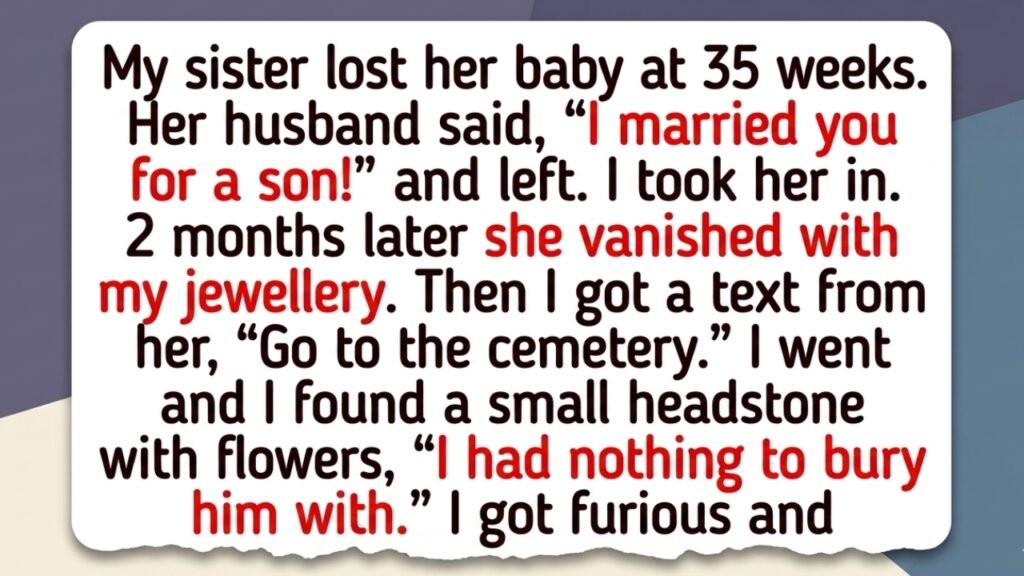
My sister lost her baby at thirty-five weeks, and her husband walked out, saying, I married you for a son. I took her in without hesitation. Two months later, she disappeared, along with every piece of jewellery I owned. I was furious and called her, ready to say things I couldn’t take back. Then I received a single text: Go to the cemetery. I went and found a small headstone with fresh flowers, her son’s name carved into it, and the words “I had nothing to bury him with. In that moment, all my anger disappeared. I called her back and didn’t mention the jewellery. I just said, Come home, we’ll figure out the rest. She returned that evening. I never replaced most of those pieces, and I’ve never once wished I had.
