
DragonFire Laser Could Arrive on UK Warships Sooner Than Expected

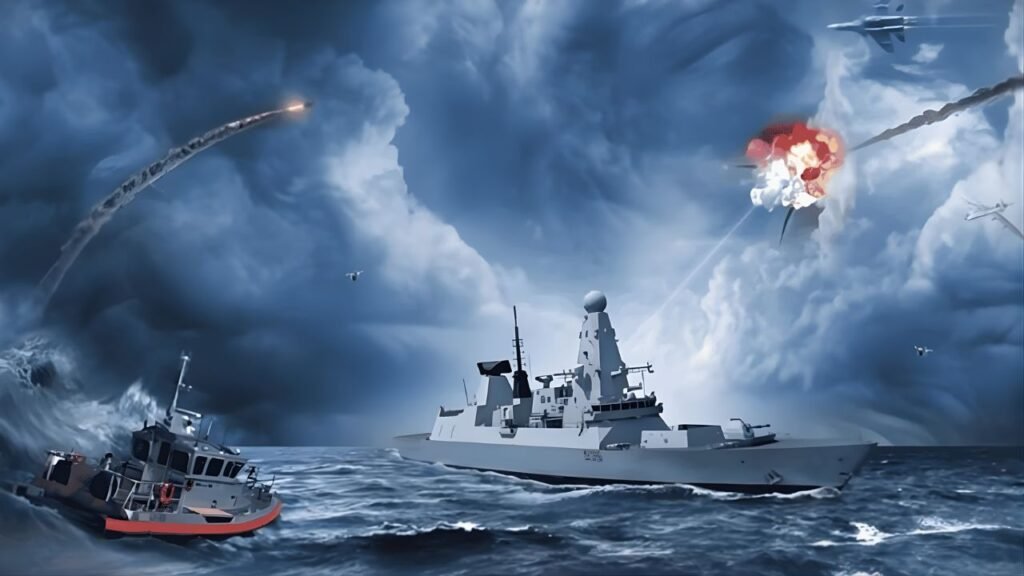
DragonFire Laser : The UK’s DragonFire laser weapon is no longer just a futuristic defence concept. It is moving much closer to operational naval use, and faster than many expected. The key shift is the timeline: instead of arriving in the early 2030s, DragonFire is now on track for Royal Navy deployment by 2027. That matters because it turns the conversation from “interesting future technology” into “near-term warship capability.”
This is a major step for British defence and for naval warfare more broadly. Directed-energy weapons have been discussed for years as a possible answer to drones, low-cost aerial threats, and the rising cost of missile-based interception. DragonFire makes that debate much more practical. If the current plan holds, UK warships could begin carrying a laser weapon far earlier than the original schedule suggested.
The phrase “sooner than expected” is not just media exaggeration here. The revised path points to a meaningful acceleration. That gives DragonFire strategic relevance now, especially at a time when navies are under pressure to deal with drone swarms, repeated low-cost threats, and the economic problem of using expensive missiles against cheap incoming targets.
Key Highlights
- DragonFire is now expected to reach Royal Navy warships by 2027.
- That timeline is significantly earlier than earlier planning assumptions.
- The system is intended to be fitted first on Type 45 destroyers.
- DragonFire is designed to counter drones and other short-range aerial threats.
- Its major advantage is cost efficiency compared with missile interceptors.
- The weapon also offers a form of “deep magazine” potential as long as power is available.
What Is DragonFire?
DragonFire is a British high-energy laser weapon system developed to engage aerial threats with extreme precision. It is part of the wider move toward directed-energy weapons, which use concentrated energy rather than physical munitions to disable or destroy a target.
That changes the economics of defence in an important way. Traditional naval air defence relies heavily on missile systems, and those missiles are effective, but expensive. DragonFire aims to give warships another layer of protection, especially against targets such as drones that may be cheap to build but dangerous in large numbers.
In simple terms, DragonFire is not supposed to replace every missile on a warship. It is better understood as a new defensive layer. It can help save missile inventory for more serious or more difficult threats while handling some lower-cost and shorter-range targets more efficiently.
Why the Accelerated Timeline Matters
Moving from an early-2030s expectation to a 2027 deployment window changes the entire story. A defence system expected “someday” is easy to talk about in abstract terms. A system expected in the next operational cycle is very different. It affects planning, procurement, integration, training, and fleet doctrine now.
For the Royal Navy, this matters because the threat environment has changed fast. Drones are no longer niche tools. They are cheap, scalable, and increasingly central in modern conflicts. Warships need better answers not just to one incoming threat, but to repeated attacks or saturation scenarios. This is where the DragonFire concept becomes especially attractive.
The earlier arrival also signals confidence. Governments do not usually compress deployment timelines by years unless the technology has reached a more serious level of maturity or the threat picture has made delay unacceptable.
Which UK Warships Could Get DragonFire First?
The most likely first hosts are Type 45 destroyers. That makes sense. These ships are already central to British air-defence operations and are built around protecting fleets and high-value assets against airborne threats. Adding DragonFire to that class would strengthen the Royal Navy’s layered defensive model rather than forcing a completely new concept onto an unrelated platform.
If integrated well, the laser would sit alongside existing systems instead of replacing them. In practical terms, the ship would still rely on conventional sensors, missiles, and command systems, but with DragonFire available for selected engagements where a laser makes more tactical and economic sense.
The first deployment is expected to be limited rather than fleet-wide. That is normal. Initial shipboard integration usually focuses on a small number of hulls before any broader rollout is considered.
Why Navies Are Interested in Laser Weapons
There are three major reasons.
1. Cost per shot
This is the headline issue. A laser shot costs far less than a missile interception. In a world where a relatively cheap drone can force the launch of a very expensive defensive missile, that imbalance becomes a serious strategic problem. A laser helps rebalance that equation.
2. Magazine depth
A missile launcher has a finite number of rounds ready to fire. A laser system works differently. It still has practical limits, such as power generation, cooling, atmospheric conditions, and firing duration, but it is not constrained in the same way as a missile magazine. That creates a major advantage in repeated engagements.
3. Speed of engagement
A laser reaches the target at the speed of light. That does not solve every combat problem, but it does make the concept highly attractive for certain fast-response defensive roles.
What DragonFire Is Most Likely to Be Used Against
DragonFire is most often discussed in the context of drones, especially fast-moving aerial systems that are dangerous but not necessarily worth a missile every time. It is also linked to defence against other relatively small, short-range or lower-cost threats.
That matters because the modern battlefield is changing. The danger is not always a single large missile. Sometimes it is repeated harassment by smaller systems designed to overwhelm, distract or drain defences. Using a traditional missile against every one of those threats can quickly become unsustainable.
DragonFire fits best where accuracy, low shot cost and repeated use matter most. It is not a magic answer to every airborne threat, but it could become extremely useful against the exact kind of threat profile that navies are seeing more often.
| DragonFire Advantage | Why It Matters at Sea |
|---|---|
| Low cost per shot | Reduces the need to spend expensive missiles on cheap targets |
| Precision | Useful for engaging small aerial threats accurately |
| Fast response | Helps against short-warning drone or air attacks |
| Layered defence role | Adds another option alongside missiles and other ship defences |
| Potential repeated use | Important in drone-swarm or persistent-threat environments |
What “Sooner Than Expected” Does Not Mean
It does not mean every Royal Navy warship will suddenly become laser-armed. It does not mean DragonFire will replace established missile systems overnight. And it does not mean the technology has no limitations.
Laser weapons still face real operating constraints. Weather can matter. Sea conditions can matter. Heat management matters. Integration with ship power systems matters. Rules of engagement matter. So while the 2027 target is a major acceleration, it should be read as the beginning of operational fielding, not the end of development forever.
That distinction is important. Early deployment is a major milestone, but real success will depend on how the weapon performs in realistic maritime conditions over time.
Why This Is Strategically Important for the UK
From a strategic point of view, the DragonFire timeline matters for three reasons. First, it supports the UK’s effort to stay relevant in advanced defence technologies. Second, it improves the Royal Navy’s ability to deal with modern low-cost threats. Third, it sends a signal that Britain wants to move from testing to fielding more quickly in areas where the threat is already visible.
There is also an industrial angle. DragonFire is not just a military project. It is part of a broader ecosystem involving British defence technology, manufacturing, and integration expertise. That makes it strategically valuable beyond its direct battlefield use.
If the Royal Navy can field a working shipborne laser by 2027, Britain will gain both operational and symbolic advantage. It would show that the UK is not just discussing future warfare, but actually putting some of its next-generation systems into service.
Could DragonFire Change Naval Defence Doctrine?
Potentially, yes, but probably in a gradual way. Doctrine rarely changes because of one system alone. What usually happens is that a new capability starts as an added option, then over time changes planning, loadouts, engagement priorities and fleet expectations.
DragonFire could push warships toward a more layered and more cost-conscious defensive model. Commanders may begin to think differently about which threat gets which response. A cheap drone does not necessarily need the same answer as a more complex missile threat. Once that logic becomes operationally normal, doctrine starts to shift.
That said, the missile age is not ending. Directed-energy systems are more likely to expand the defensive toolbox than to replace existing tools entirely.
What to Watch Next
- Confirmation of exactly which ships will receive the first systems.
- Further details on production and integration milestones.
- Operational testing in realistic naval conditions, not just controlled demonstrations.
- Whether the first deployment remains limited to two ships or expands further.
- How the Royal Navy describes DragonFire’s role inside its wider air-defence system.
Pros and Limits of DragonFire on Warships
Pros
- Much cheaper shot cost than interceptor missiles.
- Strong fit for drone defence and repeated low-cost threat engagements.
- Adds another defensive layer to existing naval systems.
- Could reduce pressure on missile stocks during sustained attacks.
Limits
- Not a replacement for every missile-based defensive role.
- Operational effectiveness at sea still needs to be proven over time.
- Environmental and technical constraints remain important.
- Initial rollout is likely to be narrow, not fleet-wide.
Conclusion
DragonFire could reach UK warships sooner than expected because the timeline has moved from distant ambition to near-term deployment. With a target of 2027 for Royal Navy integration, the system is no longer just a futuristic talking point. It is becoming a serious part of Britain’s naval defence planning.
The significance is not only technological. It is strategic and economic too. DragonFire offers a possible answer to one of the biggest modern defence problems: how to stop low-cost, repeated threats without exhausting expensive missile inventories. That alone makes it highly relevant.
The next few years will decide whether DragonFire becomes a transformational naval capability or simply an important but limited addition. But one thing is already clear: the Royal Navy’s move toward laser weapons is happening faster than many expected, and 2027 now looks like a date that matters.
FAQs
What is DragonFire?
DragonFire is a UK high-energy laser weapon designed to engage aerial threats such as drones with extreme precision and low cost per shot.
When could DragonFire appear on UK warships?
The current target points to Royal Navy deployment by 2027, which is earlier than older expectations.
Which ships are expected to get it first?
The first expected hosts are Type 45 destroyers, which already play a major air-defence role in the fleet.
Will DragonFire replace missiles on Royal Navy warships?
No. It is better understood as an additional layer of defence rather than a full replacement for missile systems.
Why is DragonFire considered important?
Because it could offer a much cheaper way to defeat drones and similar threats, helping warships preserve missile stocks for more demanding targets.
Does “sooner than expected” mean it is fully proven already?
Not necessarily. It means the fielding timeline has accelerated, but real long-term success will still depend on how the system performs once integrated at sea.
Why are laser weapons attractive for modern navies?
They offer low shot cost, fast engagement speed, and potential advantages against repeated low-cost aerial threats such as drones.